









1. Introduction
Unified Payments Interface (UPI) has reshaped the way Indians conduct digital transactions since its launch in 2016. With over 10 billion transactions per month recorded in 2025, the platform is celebrated for its speed, convenience, and, most importantly, its typically zero‑fee structure. However, as the ecosystem matures, subtle variations in charge policies have emerged across banks, merchant categories, and transaction types. This guide unpacks the current landscape of UPI transaction charges, explains why most everyday payments remain free, and highlights the few scenarios where a fee may be levied. By the end of the article, readers will be equipped to navigate UPI costs confidently, optimise their spending, and avoid surprise deductions.
2. How UPI Works – A Brief Overview
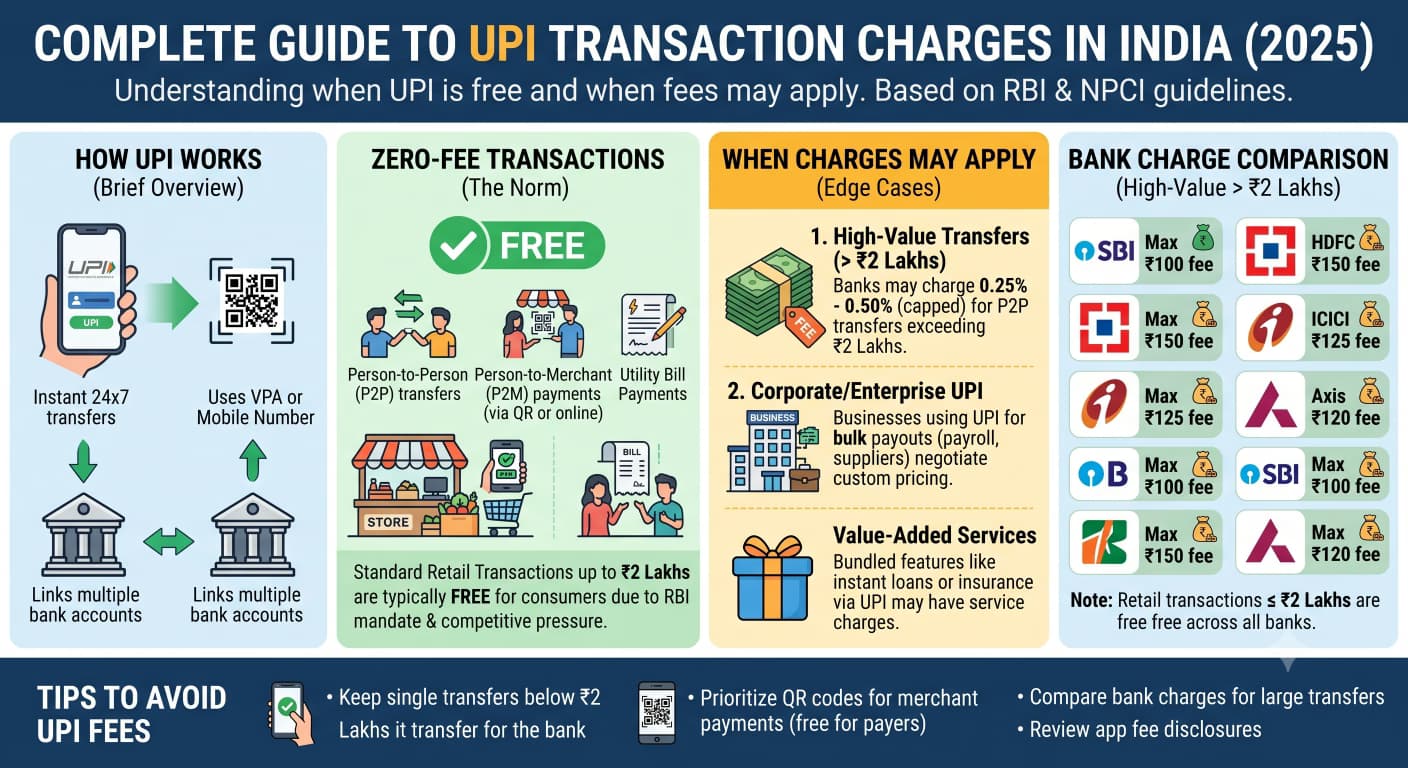
UPI is a real‑time payment system that links multiple bank accounts to a single mobile application. Users create a Virtual Payment Address (VPA) and can transfer funds using the VPA, QR code, or mobile number. The National Payments Corporation of India (NPCI) operates the backbone, while individual banks act as participants, providing the front‑end app and handling settlement. Because the system leverages the Immediate Payment Service (IMPS) network, transactions settle within seconds, 24 × 7, including holidays. The open‑architecture model encourages competition among banks and fintech firms, leading to a rich variety of UPI‑enabled apps such as Google Pay, PhonePe, Paytm, and BHIM.
3. Regulatory Framework and Fee Structure
The Reserve Bank of India (RBI) and NPCI jointly dictate the fee regime for UPI. As of the latest circular issued in March 2024, the standard retail transaction—defined as a person‑to‑person (P2P) or person‑to‑merchant (P2M) transfer of up to ₹2 lakhs—carries no charge for the end‑user. The underlying cost is absorbed by the participating banks, which are reimbursed by the NPCI on a volume‑based basis. For transactions exceeding ₹2 lakhs, banks may impose a nominal fee, typically ranging from 0.25 % to 0.5 % of the transaction value, subject to a maximum cap (often ₹100). Corporate and enterprise‑level UPI services, introduced under the “UPI for Business” framework, can attract fees based on negotiated service‑level agreements.
4. Zero‑Fee Transactions – When and Why
In practice, the majority of everyday UPI payments remain free because:
- Retail limit: The ₹2 lakh ceiling covers most personal purchases, utility bill payments, and small‑business transactions.
- Government mandate: RBI’s policy explicitly forbids banks from charging end‑users for standard retail UPI transfers, ensuring financial inclusion.
- Competitive pressure: With dozens of apps competing for market share, any bank that introduces fees for routine transfers risks losing customers to fee‑free rivals.
Consequently, a typical consumer who pays a grocery bill, splits a cab fare, or settles a utility invoice via UPI will see a zero‑balance impact on their account, apart from the transferred amount.
5. Scenarios Where Charges May Apply
While the default experience is free, certain edge cases trigger fees:
- High‑value transfers (> ₹2 lakhs): Banks may levy a fee of 0.25 %–0.5 % up to a prescribed ceiling. For example, a ₹5 lakh transfer could attract a ₹125 fee if the bank sets a 0.25 % rate with a ₹100 cap.
- Corporate UPI payments: Businesses using UPI for bulk payroll, supplier settlements, or cross‑border remittances often negotiate bespoke pricing, which can include per‑transaction or monthly subscription fees.
- Value‑added services: Some banks bundle UPI with premium features such as instant loan disbursement, insurance premium collection, or investment routing. Access to these add‑ons may carry a service charge.
- Third‑party aggregator fees: Certain fintech platforms that act as aggregators for multiple banks might add a small convenience fee for specific services, although this practice is rare and must be disclosed transparently.
It is crucial for users to review the terms of their chosen UPI app or bank to confirm whether any of the above situations apply to them.
6. Comparison of Major Banks’ UPI Charge Policies
| BankStandard Retail (≤ ₹2 Lakh)High‑Value (> ₹2 Lakh)Corporate/EnterpriseNotes | ||||
| HDFC Bank | Free | 0.30 % (max ₹150) | Negotiable – typically 0.10 % per txn | Zero‑fee for all personal UPI apps |
| SBI | Free | 0.25 % (max ₹100) | Flat ₹200 per 1,000 transactions | Offers “SBI UPI Business” with tiered pricing |
| ICICI Bank | Free | 0.35 % (max ₹125) | Custom pricing based on volume | Charges apply only on the bank’s own UPI app for high‑value transfers |
| Axis Bank | Free | 0.40 % (max ₹120) | ₹150 per 1,000 corporate transactions | Zero‑fee for QR‑code payments up to ₹2 Lakh |
| Yes Bank | Free | 0.30 % (max ₹100) | Negotiated per‑transaction fee | Provides “Yes Business UPI” with volume discounts |
The table illustrates that while all major banks honour the RBI‑mandated free retail tier, their high‑value and corporate fee structures differ. Users who frequently move large sums should compare these rates before selecting a primary UPI‑enabled bank.
7. Impact of Charges on Consumers and Businesses
For ordinary consumers, the presence of a fee on high‑value transfers has a marginal impact because such transactions are uncommon in day‑to‑day life. However, for small business owners who receive payments exceeding the retail limit—such as event ticketing, wholesale orders, or bulk utility bill settlements—the cumulative cost can erode profit margins. Corporate entities, on the other hand, treat UPI fees as an operational expense, akin to card‑network interchange fees. The transparent, volume‑based pricing model encourages businesses to negotiate better terms, especially when transaction counts run into the thousands each month.
8. Tips to Avoid Unnecessary UPI Fees
- Stay within the ₹2 lakh limit: Split large payments into multiple smaller transactions where feasible.
- Use a fee‑free bank for high‑value transfers: Some banks, like Kotak Mahindra, have announced a temporary waiver on high‑value UPI fees during promotional periods.
- Leverage UPI QR codes for merchant payments: QR‑based transactions are universally free for the payer, regardless of amount, as long as the merchant’s bank adheres to the RBI rule.
- Choose the right UPI app: Apps that route payments through a bank with lower high‑value fees can save money. Verify the fee disclosure in the app’s “Help” section.
- Consider alternative payment modes for bulk payouts: For recurring payroll above ₹2 lakhs, NEFT or RTGS may be cheaper if the bank offers free or subsidised rates.
9. Frequently Asked Questions
9.1 Is there any hidden charge when I pay a merchant using UPI?
No. Under the current RBI framework, merchants cannot levy a fee on the payer for standard UPI transactions, regardless of the amount, provided the merchant’s bank complies with the regulation.
9.2 Will I be charged for receiving money via UPI?
Receiving funds is free for both personal and business accounts. Any fee, if applicable, is borne by the sender when the transaction exceeds the retail ceiling.
9.3 Do UPI wallets like PhonePe or Google Pay add their own fees?
These wallets act as aggregators and must follow the same RBI fee structure. They may charge a nominal service fee for value‑added features (e.g., instant credit), but not for the core UPI transfer.
9.4 How can I check the fee schedule of my bank?
Visit the bank’s official website, navigate to the “UPI” or “Digital Payments” section, or consult the “Charges & Fees” tab within the bank’s mobile app. Banks are required to disclose any applicable fees transparently.
9.5 Are cross‑border UPI transactions subject to fees?
UPI is currently limited to domestic Indian bank accounts. International payments using the UPI brand (e.g., through partner networks) may involve conversion fees, but these are not part of the RBI’s domestic fee regime.
10. Conclusion
UPI’s hallmark remains its zero‑fee experience for the overwhelming majority of retail transactions, a feature that has driven its explosive adoption across India. While high‑value and corporate‑level transfers can attract modest charges, the regulatory environment ensures that these fees are transparent, capped, and competitive. By understanding the fee thresholds, comparing bank‑specific policies, and employing the practical tips outlined above, users can maximise the cost‑effectiveness of their digital payments and avoid unexpected deductions. As the ecosystem evolves, staying informed will continue to be the best strategy for both consumers and businesses.